


A thread on Reddit’s main entrepreneur forum put into words what a lot of us have been feeling.
“With near-zero barriers to entry, ideas are oversupplied and value is diluted, driving a race to the bottom.”
Every AI SaaS business looks the same now. Same landing page. Same pricing tiers. Same pitch deck. “We use AI to automate X.” Brilliant. So do the other 400 companies that launched this month.
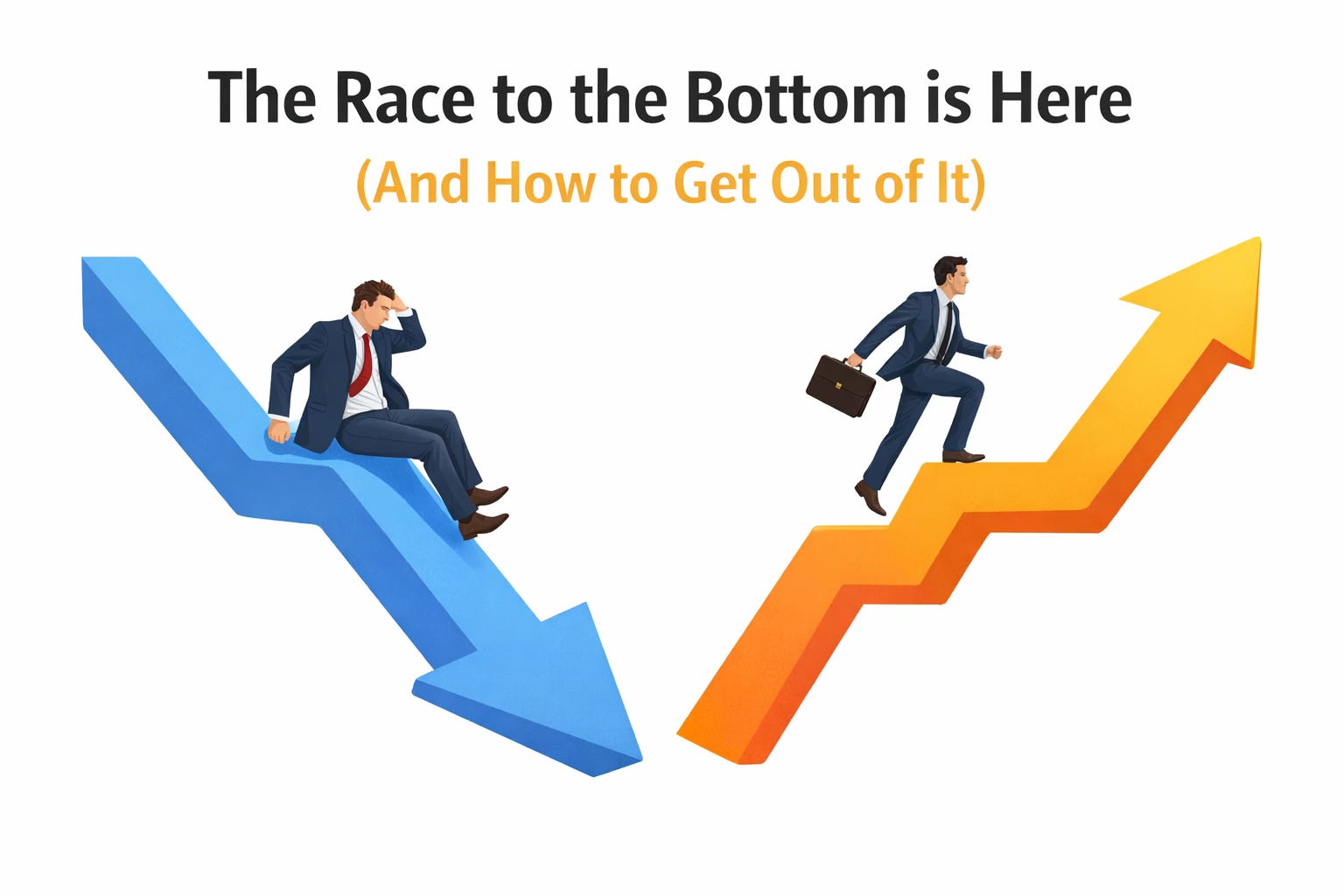
The barrier to building software collapsed. And with it, the value of software-only businesses.
TThe Great AI SaaS Commoditisation
It used to take a team of developers six months and a pile of cash to build a SaaS product. Now one person does it in a weekend with AI coding tools. That sounds like progress. And it is, in some ways.
But it also means your software idea, the one you’ve been thinking about for months, gets replicated by anyone in days. If your entire value sits in a thin layer of code, you don’t have a business. You have a feature. Features get copied.
The market is flooded. Prices drop. And the businesses that are purely digital, with no human expertise baked in, feel the squeeze first.
The bit everyone is missing
Here’s what the Reddit thread got half right. They spotted that “unsexy” physical businesses are harder to copy. True. A plumbing company won’t get replicated by a teenager with Cursor and a weekend.
But the real moat isn’t physical vs digital. It’s human vs automated.
Top comment on r/Entrepreneur (85 upvotes): “Unsexy, physical products look more resilient because they’re harder to copy.”
They’re right about resilience. Wrong about the reason. Those businesses are hard to copy because they need human judgement, human relationships, and human skills at the centre. The plumber reads the room, not a dashboard. The consultant who knows your industry inside out brings 20 years of pattern recognition no model has.
The moat is the human, not the bricks.
Why “human in the lead” wins
AI is the most powerful business tool most of us will see in our lifetimes. I use it for everything I reasonably can. But here’s what I’ve learned working with businesses on AI strategy every single week.
The businesses getting real results don’t replace their people with AI. They put their people in the lead and let AI do the heavy lifting behind them.
I call it the 10-80-10 approach. 10% human input to set direction. 80% AI execution to do the work. 10% human refinement to make it right. The human starts the process. The human finishes it. AI handles the middle.
That ratio matters. Strip the human from either end and you get generic, forgettable, commodity output. The same slop everyone else produces. The same landing page. The same pitch deck.
The moats that hold up
If you’re looking at your business and wondering “could someone copy this in a week?”, here are the moats that still hold.
Human expertise. If your value comes from years of experience in a specific field, from knowing which questions to ask and which answers to ignore, no tool replaces that. The accountant who knows your business inside out. The consultant who sits in your boardroom. The strategist who spots the problem before the data does. That’s a moat.
Relationships built over years. Trust takes time. It takes shared problems and solved crises. A new competitor with better software won’t take your client if your client trusts you with their business. Relationships compound. Software depreciates.
Proprietary knowledge. If you’ve spent years learning how a specific industry works, how its people think, what breaks and why, that’s knowledge no AI has been trained on. Your customer insights. Your sector benchmarks. Your hard-won understanding of what works on the ground.
The human skill stack. Leadership. Communication. Reading a room. Asking the right question at the right time. Knowing when to push and when to hold. These are the skills AI amplifies but will never own.
The practical bit
Ask yourself one question. What does my business do that requires a skilled human to lead it?
Is it the discovery call where you diagnose the real problem? The strategy session where experience guides the recommendation? The relationship with a client built over five years of delivering? The ability to read between the lines of what a customer asks for and what they need?
Find it. Name it. Then build everything around it.
Use AI to remove the admin, the repetitive tasks, the 80% in the middle that drains your time. Free your people to do the 20% that no machine replicates.
That’s your moat. The human at the centre.
Protect it.
Ben
PS: I’m not anti-AI. I spend my days helping businesses put AI to work. But the businesses winning aren’t the ones replacing humans with AI. They’re the ones who made their humans better with AI. Know the difference.