


Only 8% of ChatGPT’s citations come from Google’s top 10 organic results.
Read that again.
You’ve spent years (and probably thousands of pounds) getting your website onto Google’s first page. And now the AIs that are replacing search barely look at it.
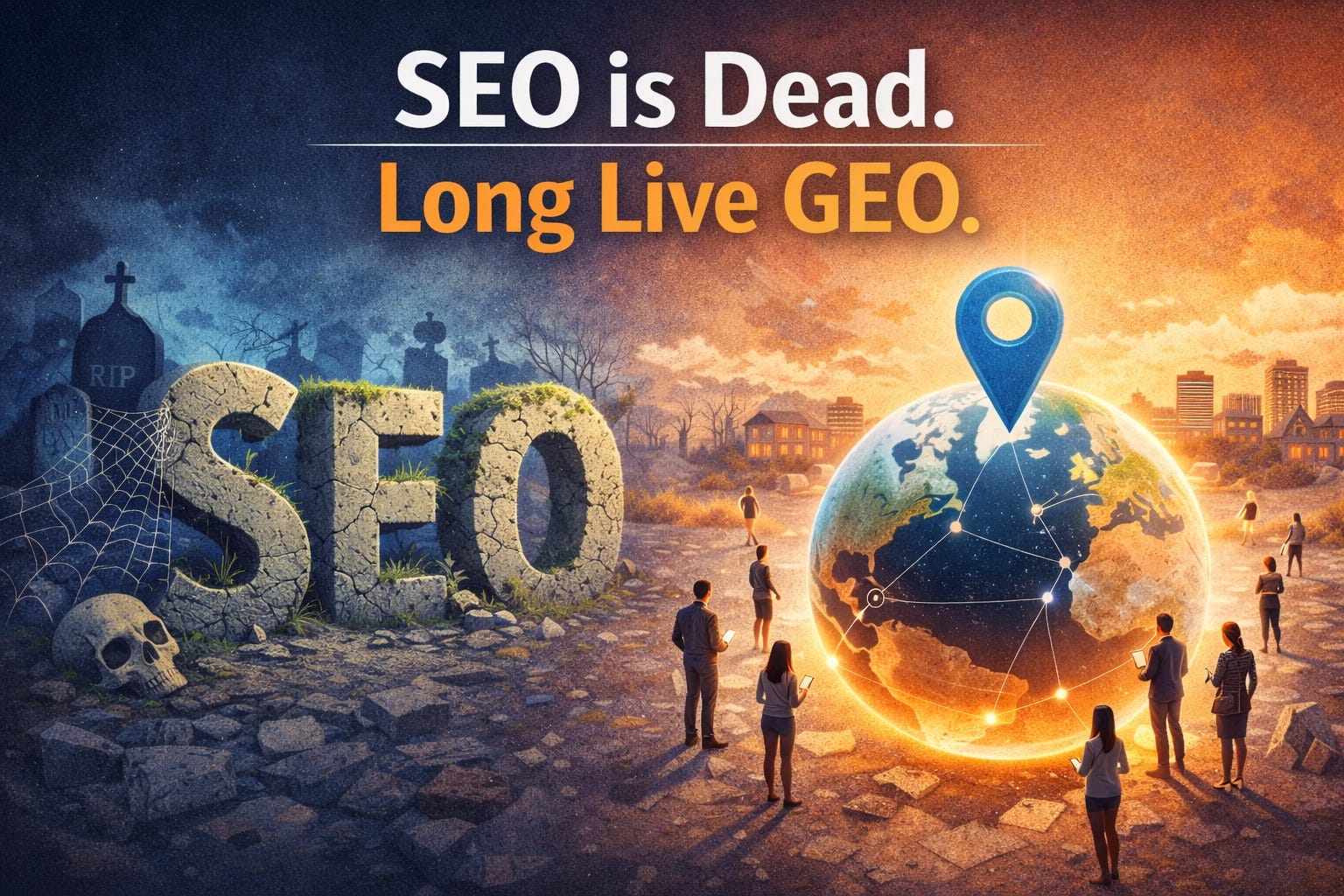
The game isn’t Search Engine Optimisation anymore. It’s Generative Engine Optimisation. GEO. And if you haven’t heard of it, you’re not alone. But you need to.
What’s actually happening.
People are changing how they find things. Instead of typing a query into Google and scanning a list of blue links, they’re asking ChatGPT, Gemini, or Copilot a question and getting a direct answer. One answer. With citations.
Your website either gets cited in that answer, or it doesn’t exist.
Gartner predicts a 25% drop in traditional search engine usage by 2026. We’re already seeing it happen. And here’s the kicker. The AIs aren’t pulling their citations from the same places Google ranks highly.
Where AI actually gets its information.
This is the bit that’ll make your SEO agency uncomfortable.
Reddit accounts for 40.1% of all generative AI citations worldwide. Reddit. Not your beautifully optimised landing page. Not your blog post stuffed with keywords. Reddit.
After that? Wikipedia. YouTube transcripts. Forums. Academic papers. Places where real people share real, specific, structured information.
The common thread? These sources present information clearly. They answer questions directly. They don’t hide the answer behind three paragraphs of waffle and a cookie consent banner.
The four principles of GEO.
So how do you optimise for AI instead of Google? It’s not complicated, but it does require a different mindset.
1. Structure for extraction. AI models love clean, scannable content. Think FAQs, bullet points, numbered lists, tables. If a human could scan it and get the answer in 5 seconds, an AI can extract it even faster.
2. Answer the actual question. Stop writing around the topic. If someone asks “how much does a new kitchen cost in the UK?”, put the answer in the first sentence. Not after 400 words of “Planning a new kitchen is an exciting journey...” Nobody asked about the journey. They asked about the cost.
3. Be the authority, not the aggregator. AI models prioritise sources with original data, specific expertise, and clear attribution. If your content is just repackaging what five other websites said, the AI will go to those other websites instead.
4. Use language the AI can cite. Write in complete, factual statements. “The average cost of a UK kitchen renovation in 2026 is between £8,000 and £25,000 depending on scope.” That’s citable. “Kitchens can vary widely in cost depending on many factors” is not.
Why this is actually good news for small businesses.
I think this is the part people miss. Traditional SEO was a resource war. Big companies with big budgets and dedicated teams dominated the first page. You were competing against their domain authority, their backlink profiles, their content teams.
GEO is different. It rewards specificity and genuine expertise over brute force. A plumber in Sheffield who writes a clear, detailed FAQ about common boiler problems has a better shot at being cited by an AI than a national chain with a generic service page.
The playing field is shifting. And it’s shifting in your favour, if you move now.
The Practical Bit
Go to your most important service page. The one that should be bringing in business.
Rewrite the first three paragraphs as a simple Q&A. Use clear, direct questions as subheadings. Define any jargon. Structure the information so a five-year-old could understand it.
That’s how you start winning at GEO.
Here’s what works.
Ben
PS: Your SEO work isn’t wasted. Good SEO and good GEO overlap in places (clear structure, quality content, fast loading). But if you’re only optimising for Google in 2026, you’re optimising for a shrinking audience. Time to think bigger.