


Judge Group, a Fortune 500 services firm, just cut contract reviews from six hours to one hour. Their annual compensation workflow dropped from 60 days to 10 hours. (Source)
Most people read that and think, “right, we need better AI.”
They’ve got it backwards.
The thing is, the AI wasn’t the clever bit. The clever bit happened before anyone typed a prompt. It’s the step everyone skips because it’s boring, unglamorous, and doesn’t make a good LinkedIn post. And it’s the reason your last AI experiment quietly died in a forgotten browser tab.
Let’s be honest. You’ve probably tried this already. Someone on the team got excited about ChatGPT, fed it a contract, asked it to “summarise the key terms,” and got back something that looked impressive for about ninety seconds. Then you tried a second contract. Different format. Different output. Nothing you could actually use across a stack of fifty.
You concluded AI wasn’t ready. Or your data was too messy. Or your business was too bespoke.
None of those are true. You just skipped the boring step.
What Judge Group actually did
Here’s the bit the press release buried under a layer of corporate gloss.
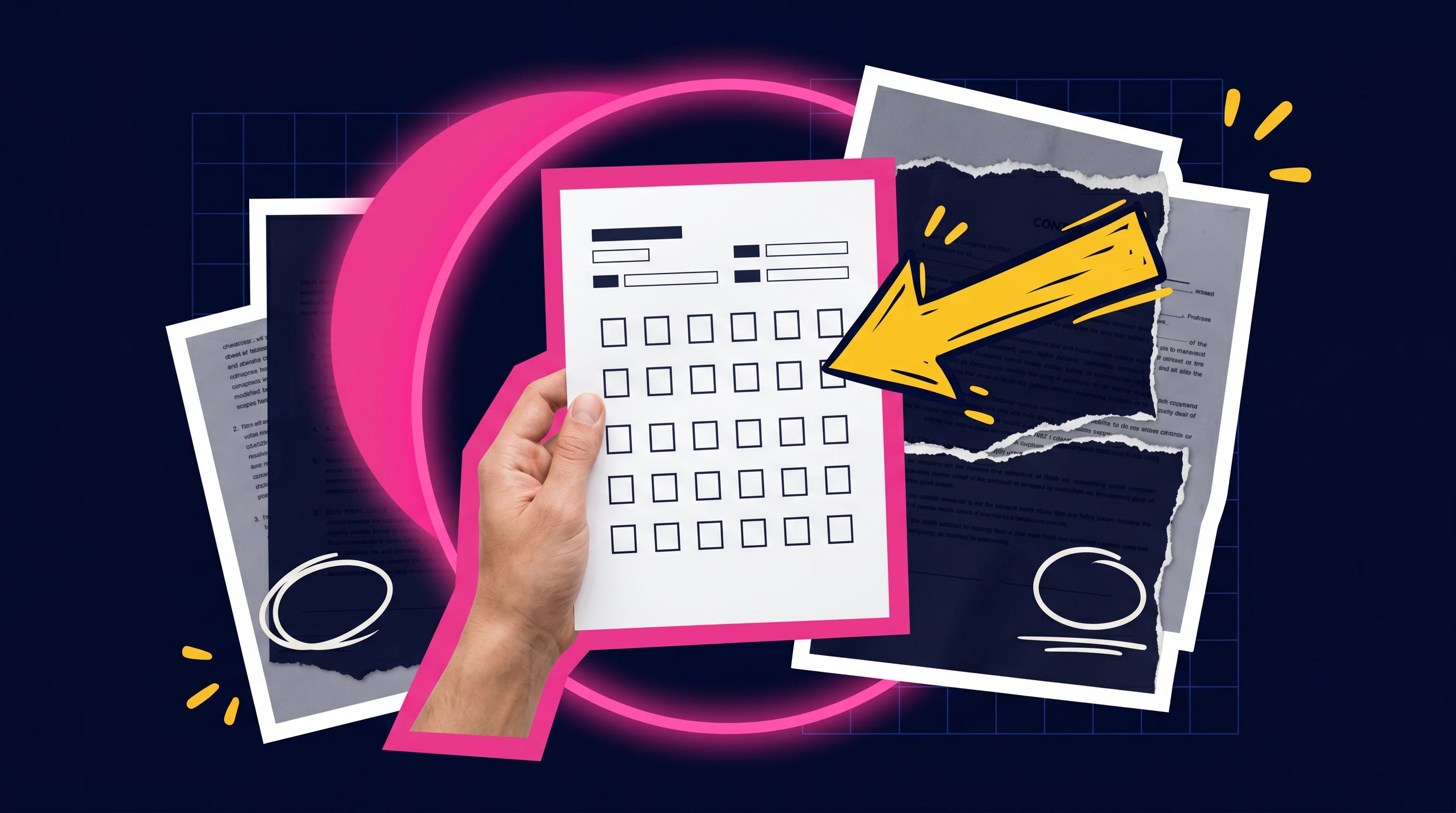
Judge Group used Box Extract and Box AI Studio to run 49 specific compliance checks against every contract that came in. (Box) Forty-nine. Not “summarise this.” Not “find the risks.” Forty-nine named, defined, repeatable questions with expected answer formats.
That’s the whole game. They didn’t ask AI to be clever. They asked it to be a very fast, very tireless intern with a checklist.
Before any AI touched a document, someone sat down and wrote that checklist. Field name. Definition. Where it usually appears. What a good answer looks like. What a red flag looks like.
That document, the one nobody photographed for the case study, is what took six hours of senior reviewer time and squashed it into sixty minutes.
The AI is the cheap bit. The metadata template is the expensive bit. And by expensive, I mean one afternoon of clear thinking from someone who actually understands the work.
The press release buried the real lesson
Box’s own blog quotes the principle directly. “AI contract review only works when you structure unstructured data first.” (The AI Report via Box)
That sentence should be tattooed on every SME owner’s forearm before they buy another AI tool.
Structure the inputs. Then automate.
Not the other way round.
The reason this gets buried is obvious. Software companies sell software. They want you focused on their shiny extraction engine, not on the unsexy thinking work that makes the engine useful. So the headline is “Box AI cuts review time by 83 percent.” The truth is “smart humans defined 49 fields, then Box AI filled them in fast.”
Spare me the hype. The hype is a distraction.
Why “AI didn’t work for us” usually means something else
Here’s the thing nobody says out loud at the AI conferences.
When an SME tells me “we tried AI on our contracts and it was rubbish,” nine times out of ten what actually happened is this. They opened ChatGPT. They pasted in a contract. They asked an open question like “what should I worry about in this?” They got a generic answer. They tried a second document. The answer was structured differently. They couldn’t put the two side by side. They gave up.
That’s not AI failing. That’s a process failing.
You wouldn’t hire a paralegal and say “read this, tell me anything interesting.” You’d give them a checklist. Renewal date. Notice period. Liability cap. Auto-renewal clause. Payment terms. Penalty rates.
The checklist is the work. The reading is the easy part.
AI is the same. Give it the checklist and it’s a quiet, accurate machine. Give it vibes and it gives you vibes back.
The SME version, no Box licence required
You don’t need a Fortune 500 contract with Box. You need three things you already have.
A Google Sheet. Claude (or ChatGPT, fine, I’m not religious about it). A folder of documents you process every week.
Pick one document type. Supplier contracts. Quotes from subbies. Planning permissions. NDAs. Insurance certificates. Whichever one your team handles often enough that the boredom is real.
Open three real examples on your desk. Not the cleanest three. Three normal, slightly annoying ones.
Write down the 5 to 10 fields you always end up pulling out by hand. The bits you squint for. Renewal date. Counterparty name. Total value. Termination clause. Payment terms. Indemnity cap. Governing law.
That list is now a metadata template. Welcome to the boring step. You just did it.
Drop your three sample documents into Claude along with the list. Ask it to return the answers in a table, one row per document. Read the output critically. Where did it guess? Where did it get confused? Adjust the field definitions. Run it again.
By the end of the afternoon you’ll have an extraction routine that works. By Friday you’ll have run it across fifty documents in the time it used to take to do three.
Here’s what works. A tight checklist of named fields with clear definitions, fed to a capable model, with a human spot-checking the output for the first week.
Here’s what doesn’t. “AI, please be helpful with these contracts.”
Why this beats every shiny AI launch this year
Every fortnight there’s a new model, a new agent, a new framework, a new platform that claims to do your job for you out of the box.
None of them solve the actual bottleneck.
The bottleneck isn’t model intelligence. The models are already smarter than they need to be for 90 percent of SME work. The bottleneck is that nobody has written down what they actually want, in a format that’s repeatable, measurable, and boring.
Once you’ve done that, the choice of model becomes almost a footnote. Claude, GPT, Gemini, whatever. They’ll all do the job. The work that matters is the thinking you did before you opened the chat window.
That’s the bit no software vendor will sell you, because it’s not software. It’s about an hour of an experienced human’s attention. Yours, probably.
At the end of the day, the SMEs who win at AI over the next two years won’t be the ones with the biggest tooling budget. They’ll be the ones who sat down for ninety quiet minutes per workflow and wrote the checklist.
The Practical Bit. The Five-to-Ten Audit.
Block ninety minutes this week. Diary it. Don’t tell anyone.
Pick one document type your team processes every single week. Supplier contracts. Planning permissions. Customer quotes. Onboarding forms. NDAs. Whichever one bleeds the most hours.
Pull three real examples. Not perfect ones. Real ones.
List the 5 to 10 fields you always extract by hand. Name them. Define them in one sentence each. Note where they usually appear in the document.
That list is your metadata template.
Hand it to Claude with the three sample documents. Ask it to return a table, one row per document, one column per field. Check the output. Tighten the definitions where it stumbled. Run it again.
By Friday, you’ve got a working extraction agent. By next month, you’ve got hours back every week.
Total spend. Zero.
PS. If your first instinct reading this was “we’ll need to buy a tool first,” that’s exactly the trap Judge Group avoided. They built the checklist before they built the workflow. You can too, on a sheet of A4.